31 January this year marked my 35th year as public official. I started off my career at a small Local Municipality in the Free State (Brandfort Municipality). It was a steep learning curve as it was basically me, the Electrotechnical Manager, CFO and MM that had to make local government work. My responsibilities included everything from doing meat inspections at the abattoir to EHP services, building control supervising the town’s clinics and then also providing an emergency service with the town’s ambulance. My five years at Local government shaped me as a public servant, always striving to deliver a better service and trying to speak for the voiceless. This level of government, closest to the people, remain my focus point but I also realised that especially emergency services is better coordinated from a district or even Provincial perspective.
Soon after moving over to the Klein Karoo District Municipality, more than 30 years ago, I was confronted with the white paper on Disaster Management, and this is when I realised that in this field, I could be instrumental to protect not only the lives of people but also our environment. I enrolled at the University of the Free State in their structured Master’s Degree program and under the guidance of Professor Andries Jordaan, I was honed in the skills required to become a Disaster Manager.
In my career to date I have had to deal with various floods, hail storms, droughts, wildfires, a vessel standing on a Nationally protected area next to Buffalo Bay, aircraft incidents, a building collapse in George, animal disease outbreaks including swine fever, avian influenza and the latest foot and mouth disease and maybe the worst to date the National Pandemic Corona Virus.
It is hard to differentiate between what disaster proved to be the most challenging as each disaster brings a new set of obstacles to overcome to highlight a couple in my career:
In 2005 I Project Managed the building of the fist disaster management centre on district level in our Province, my goal was to set a coordination platform from where major incidents and disasters could be managed but also to create one emergency call centre from where all first responders could be dispatched including EMS, Fire, Traffic and SAPS. Today 21 years later at last SAPS is also on board. This centre on a monthly basis receives in excess of 25 000 emergency calls peaking at more than 35 000 calls during December and January. All calls are voice logged, time and date stamped and availiable to be used for continuous training of call takers to continuously hone their skills.
After the worst hail disaster in years in the Langkloof in 2006 I had to fly to Pretoria to convince the officials at the Department of Agriculture that their policies required change, at that point in time the fruit tree was not seen the same to a fruit farmer as the cow to a milk farmer. We also for the first time tested the training layoff scheme from the Department of Labour, the end result was that no farm worker lost his job, the fruit trees could be treated to be back into production within a record time and when assessing the farms later that year, the farmers told me that now they no longer have to tell their workers when to prune or what needs to be done next, because after receiving their training they now go on by their own accord, as now they knew why certain things had to be done to ensure maximum production.
When the Kiani Satu vessel ran ashore on the Nationally Protected Area next to Buffalo Bay it was clear that our colleagues at Oceans and Coast required some guidance towards proper management of incidents, after introducing the officials to the incident command system (ICS) that we have been using for fire incidents, they adopted this approach Nationally and now deal with all their incidents as per these guidelines.
In 2010 I was called by the Knysna Technical Service Department with the following words “ we only have 48 hours of water in our main reservoir supplying water to the Sedgefield community, now it is a disaster and you must come and help please” By the grace of my creator nobody ever went without water, we managed to build an emergency pipeline within one week and water remained flowing to the town. Co-chairing the drought interventions with Dr Hildegarde Fast from DPLG was a great honour. The work ethic of this lady inspired me, and the nett result was that millions of rands in disaster grant funding got pumped into the building of water security for the district, interventions that really kept and are still keeping many of the water service authorities in the district capable of providing in the daily water demand of their consumers.
The devastation of the 2017 Knysna wildfires called for a new approach to ensure recovery and rebuild, I was privileged to once again work next to Dr Fast as the co-chair of the Garden Route Rebuild Initiative (GRRI) and amongst other our current Training Mecca stem form initiatives started by the GRRI.
When Covid struck in 2019, I lost two years of my life, as the commander of the district covid JOC normal 8-hour workdays turned into 18-hour workdays. Everyone demanded an answer and we were building the plane while flying it. Once again, I learned valuable lessons and to see how historical silos could be broken down towards achieving a common goal was really amazing. Being allowed to become part of extended cabinet meetings allowed for rapid decision taking to address complex situations.
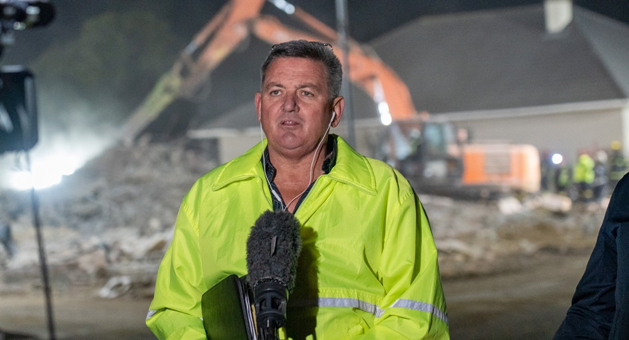
Last year with the collapse of the five story building virtually a stone throw from the GRDM Disaster Centre the reality of what we work with once again struck me, I was at the site every morning at 4h00 at fist in the silence of the night you could still hear some voices but gradually this turning to a bad odour filling the air Yet we never lost hope to find if only one more person alive. The coordination of this internationally watched incident was daunting to say the least, but I think we managed to set a benchmark for others to follow.